





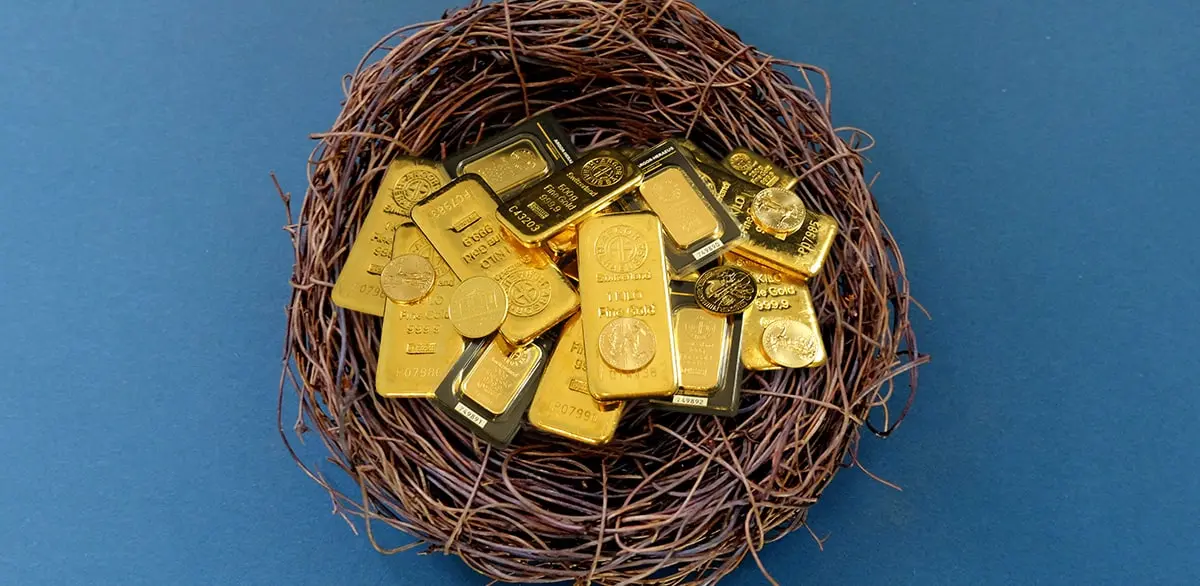
What Is an IRA Gold Kit? (And What's Inside)
An IRA gold kit packages three items — a printed guide, a fee schedule, and an IRS-approved metals catalog — that gold IRA companies mail free to rollover prospects. A gold IRA is a self-directed IRA (SDIRA) that holds IRS-approved physical metals — gold (.9999 fine), silver (.999), platinum (.9995), and palladium (.9995) — instead of stocks or mutual funds.
Most kits include: a printed or digital investment guide explaining the gold IRA process, a company fee schedule listing setup fees ($50–$150), annual custodian fees ($75–$300), and storage fees ($100–$300/year), a metals catalog showing IRA-eligible coins and bars, and a comparison checklist for evaluating providers side by side.
IRS Publication 590-A requires that gold held in a self-directed IRA meet a minimum fineness of .995 (24-karat equivalent). IRC Section 408(m) approves the American Gold Eagle and Canadian Maple Leaf but excludes all numismatic and collectible coins.
An IRA gold kit packages three items — a printed guide, a fee schedule, and an IRS-approved metals catalog — that gold IRA companies mail free to rollover prospects. A gold IRA is a self-directed IRA (SDIRA) that holds IRS-approved physical metals — gold (.9999 fine), silver (.999), platinum (.9995), and palladium (.9995) — instead of stocks or mutual funds.
What's Typically Inside a Free IRA Gold Kit
- Printed or digital investment guide explaining the gold IRA rollover process
- Company fee schedule: setup fees ($50–$150), annual custodian fees ($75–$300), storage fees ($100–$300/year)
- IRA-eligible metals catalog (American Gold Eagle, Canadian Maple Leaf, PAMP Suisse bars)
- Company comparison checklist: fees, minimums, BBB rating, buyback policy
- IRS rules summary: eligible metal fineness standards (.995+ for gold)
IRS Publication 590-A requires that gold held in a self-directed IRA meet a minimum fineness of .995 (24-karat equivalent). IRC Section 408(m) approves the American Gold Eagle and Canadian Maple Leaf but excludes all numismatic and collectible coins. Krugerrands fail the IRA fineness test (0.9167 gold vs. the 0.995 IRS minimum) despite their popularity among retail investors.
Free IRA Gold Kit: What Each Top Company Includes
The five leading gold IRA companies each offer a free kit, but contents, delivery speed, and detail level vary significantly — Augusta's kit includes an economist webinar led by Harvard-trained economist Devlyn Steele; Goldco's includes a printed guide and DVD. Note: the '$100 free gold coin offer' advertised online is typically a bonus coupon toward a first purchase, not a free coin shipped without investment.
The five leading gold IRA companies each offer a free kit, but contents, delivery speed, and detail level vary significantly — Augusta's kit includes an economist webinar; Goldco's includes a printed guide and DVD.
We requested free IRA gold kits from all five ranked companies, reviewed contents, timed delivery, mystery-shopped customer service, and cross-referenced fee schedules with custodian disclosures.

How to Request Your Free Gold IRA Kit (Step-by-Step)
Requesting a free IRA gold kit takes under two minutes: submit your name, email, and phone number on the company's site; kits are typically delivered within 3–5 business days by mail or immediately by PDF.
An IRA gold kit walks investors through metal selection — gold coins, silver bullion, platinum bars — and maps each option to IRS eligibility rules and storage requirements.
Requesting a free IRA gold kit takes under two minutes: submit your name, email, and phone number on the company's site; kits are typically delivered within 3–5 business days by mail or immediately by PDF.
Step 1: Choose a Gold IRA Company
Compare at least three providers using the table above. Focus on BBB rating, fee transparency, minimum investment, and whether the kit includes a fee schedule (critical for avoiding hidden charges).
Step 2: Submit Your Request
Visit the company's website and fill out the free kit request form. You'll typically need your name, email, phone number, and approximate investment timeline. There is zero cost and no obligation.
Step 3: Review the Kit Contents
When your kit arrives, focus on three things: the fee schedule (setup + annual + storage), the IRA-eligible metals list, and the buyback policy. Side-by-side fee comparison across at least two kits typically reveals a $100–$200/year spread in custodian costs — meaningful over a 10-year hold.
Step 4: Schedule a Consultation
Most companies offer a free, no-obligation phone or video consultation. Use this to ask about trustee-to-trustee transfer timelines, IRS Form 5498 reporting, and whether storage is segregated or commingled.
IRS Rules for Gold IRAs: Eligible Metals and Purity Standards
The IRS requires gold held in a self-directed IRA to meet a minimum .995 fineness; American Gold Eagles, Canadian Maple Leafs, and PAMP Suisse bars qualify — numismatic coins and collectibles do not.
Under IRC Section 408(m), the following metals are IRA-eligible:
- Gold: Minimum .995 fineness (.9999 fine preferred) — American Gold Eagle, Canadian Gold Maple Leaf, Austrian Philharmonic, PAMP Suisse gold bars
- Silver: Minimum .999 fineness — American Silver Eagle, Canadian Silver Maple Leaf
- Platinum: Minimum .9995 fineness — American Platinum Eagle
- Palladium: Minimum .9995 fineness — Canadian Palladium Maple Leaf
Excluded: Numismatic (collectible) coins, jewelry, and metals that do not meet minimum fineness standards. Krugerrands fail the IRA fineness test (0.9167 gold vs. the 0.995 IRS minimum) despite their popularity among retail investors. See IRS Publication 590-A for the complete fineness requirements.
The IRS requires gold held in a self-directed IRA to meet a minimum .995 fineness; American Gold Eagles, Canadian Maple Leafs, and PAMP Suisse bars qualify — numismatic coins and collectibles do not.
IRA-Eligible Metals by Category
- Gold (.995+ fineness): American Gold Eagle, Canadian Maple Leaf, Austrian Philharmonic, PAMP Suisse bars
- Silver (.999+ fineness): American Silver Eagle, Canadian Silver Maple Leaf
- Platinum (.9995+ fineness): American Platinum Eagle
- Palladium (.9995+ fineness): Canadian Palladium Maple Leaf
What's NOT Eligible
- Numismatic or collectible coins (explicitly excluded under IRC Section 408(m))
- Krugerrands (do not meet fineness requirements for IRAs)
- Jewelry and decorative items
- Metals stored at home or in a personal safe deposit box

Gold IRA Fees Explained: Setup, Annual, and Storage Costs
Gold IRA investors typically pay a one-time setup fee ($50–$150), an annual custodian fee ($75–$300), and an annual storage fee ($100–$300) — totaling $225–$750/year before metal spreads.
Gold IRA investors typically pay a one-time setup fee ($50–$150), an annual custodian fee ($75–$300), and an annual storage fee ($100–$300) — totaling $225–$750/year before metal spreads.
At a $25,000 account size, a $500 annual fee load equals 2.0% drag; at $50,000 it drops to 1.0%. For comparison, a Vanguard gold ETF (VGPMX) charges 0.39% — so a gold IRA needs roughly 8 years of 1.5% outperformance to break even at $50K. Augusta Precious Metals is known for transparent pricing with no hidden setup charges.
Gold IRA Rollover vs. Transfer: Rules and Costly Mistakes
A direct transfer (custodian-to-custodian) is the safest funding method — no 60-day deadline, no 20% withholding tax risk, and no one-per-year rollover limit applies. It can be funded via a direct trustee-to-trustee transfer (no tax event) or a 60-day indirect rollover from an existing 401(k), 403(b), SEP IRA, or SIMPLE IRA.
A direct transfer (custodian-to-custodian) is the safest funding method — no 60-day deadline, no 20% withholding tax risk, and no one-per-year rollover limit applies.
Direct Transfer (Recommended)
In a trustee-to-trustee transfer, funds move directly from your existing IRA custodian to your new self-directed IRA custodian. You never touch the money, so there is no tax event, no withholding, and no limit on how many transfers you can do per year.
60-Day Indirect Rollover
With an indirect rollover, you receive the funds personally and have 60 calendar days to deposit them into your new gold IRA. If you miss the deadline, the IRS treats it as a taxable distribution plus a 10% early withdrawal penalty if you're under 59½. Your previous custodian may also withhold 20% for federal taxes.
Eligible Account Types for Rollover
- Traditional IRA and Roth IRA
- 401(k) and Roth 401(k)
- 403(b) plans
- SEP IRA and SIMPLE IRA (after 2-year waiting period for SIMPLE)
- Thrift Savings Plan (TSP)

What Is a Gold IRA Custodian and Why Do You Need One?
Every gold IRA requires an IRS-approved custodian — a bank, trust company, or licensed non-bank entity — to administer the account; you cannot self-custody IRA-held metals under IRC Section 408.
Your custodian manages account paperwork, ensures compliance with IRS rules, facilitates purchases and sales of metals, coordinates with depositories, and provides annual tax reporting via IRS Form 5498 and Form 1099-R.
Every gold IRA requires an IRS-approved custodian — a bank, trust company, or licensed non-bank entity — to administer the account; you cannot self-custody IRA-held metals under IRC Section 408.
Top Gold IRA Custodians
- Equity Trust Company — largest SDIRA custodian, 50+ years experience, preferred by Augusta Precious Metals
- STRATA Trust Company — formerly Self Directed IRA Services; competitive flat-fee structure
- Kingdom Trust — 100,000+ accounts; supports gold, silver, crypto, and real estate SDIRAs
- The Entrust Group — 40+ years, supports 15+ alternative asset types
Custodian vs. Dealer
The custodian holds and administers the account; the dealer sells you the metals. Some gold IRA companies (like Augusta Precious Metals) coordinate with preferred custodians to create a seamless experience, handling all paperwork between the custodian, depository, and investor.
Gold IRA Storage Options: Segregated vs. Commingled
IRS rules require gold IRA metals to be stored at an approved depository (e.g., Brink's Global Services, Delaware Depository, International Depository Services); segregated storage keeps your specific bars/coins separate and costs $25–$100/year more than commingled. Home storage IRAs are illegal — McNulty v. Commissioner (2021) confirmed the IRS treats home-stored IRA metals as a taxable distribution, triggering ordinary income tax plus the 10% early withdrawal penalty.
IRS rules require gold IRA metals to be stored at an approved depository (e.g., Brink's, Delaware Depository); segregated storage keeps your specific bars/coins separate and costs $25–$100/year more than commingled.
Segregated vs. Commingled Storage
Segregated storage means your exact coins and bars are stored separately in your own allocated space. Commingled storage pools your metals with other investors' holdings of the same type. Segregated costs more ($150–$300/year vs. $100–$200/year) but guarantees you receive the exact items you purchased upon distribution.
Top IRS-Approved Depositories
- Delaware Depository (Wilmington, DE) — most popular; Lloyd's of London insurance; segregated and commingled options; used by Augusta and Goldco
- Brinks Global Services — multiple U.S. vault locations; institutional-grade security; preferred by American Hartford Gold
- International Depository Services (IDS) — Delaware and Texas facilities; competitive rates; STRATA Trust preferred partner
- JP Morgan Chase Vault — used for large institutional-grade storage
All approved depositories maintain comprehensive insurance covering theft, damage, and natural disasters, with multi-layered security including armed guards, biometric access, 24/7 surveillance, and seismic-rated vaults.

RMDs, Taxes, and Exit Strategies for Gold IRAs
Gold IRA holders must begin required minimum distributions (RMDs) at age 73 under SECURE 2.0; distributions can be taken as cash (depository sells metals) or as in-kind physical delivery, with the latter triggering ordinary income tax on fair market value.
Traditional gold IRA contributions are tax-deferred — you pay no taxes on gains until withdrawal. Roth gold IRA contributions are made with after-tax dollars, so qualified withdrawals in retirement are tax-free. Early withdrawals before age 59½ trigger a 10% penalty plus ordinary income tax on the distribution amount.
Gold IRA holders must begin required minimum distributions (RMDs) at age 73 under SECURE 2.0; distributions can be taken as cash (depository sells metals) or as in-kind physical delivery, with the latter triggering ordinary income tax on fair market value.
Tax Treatment by IRA Type
- Traditional Gold IRA: Tax-deferred growth; ordinary income tax on distributions; RMDs at age 73
- Roth Gold IRA: After-tax contributions; tax-free qualified withdrawals; no RMDs during owner's lifetime
- SEP Gold IRA: Employer-funded; same tax rules as traditional IRA; higher contribution limits
Distribution Options
When taking distributions, you can choose cash liquidation (depository sells your metals at market price and sends cash) or in-kind delivery (you receive the physical gold/silver). In-kind delivery triggers ordinary income tax on the fair market value of the metals at the time of distribution.
Top 5 Gold IRA Companies: Kit Quality, Fees, and Minimums Compared
Augusta Precious Metals, Goldco, American Hartford Gold, Birch Gold Group, and Noble Gold lead the 2026 rankings — compared below on kit quality, minimums, fees, and BBB rating.
Company ratings reflect weighted criteria: kit quality (20%), fee transparency (25%), BBB standing (20%), minimum investment (15%), and customer support (20%).
Augusta Precious Metals, Goldco, American Hartford Gold, Birch Gold Group, and Noble Gold lead the 2026 rankings — compared below on kit quality, minimums, fees, and BBB rating.
Why Augusta Precious Metals Ranks #1
Augusta stands out for its education-first approach: every prospective client receives a free one-on-one web conference led by their director of education covering current economic conditions, IRS rules, and how gold IRAs work — with zero obligation. Augusta also offers lifetime customer support through a dedicated account manager, transparent pricing with no hidden fees, and has earned an A+ BBB rating with zero complaints.
How We Ranked These Companies
We requested free IRA gold kits from all five ranked companies, reviewed contents, timed delivery, mystery-shopped customer service, and cross-referenced fee schedules with custodian disclosures. Company ratings reflect weighted criteria: kit quality (20%), fee transparency (25%), BBB standing (20%), minimum investment (15%), and customer support (20%).
Is the Free Gold IRA Kit Legitimate?
Yes — free gold IRA kits from BBB A+ rated companies (Augusta Precious Metals, Goldco, American Hartford Gold) are legitimate educational materials, not scams. Companies recover marketing costs through the 3–5% metal spread on eventual purchases, not by charging for the kit itself.
Red flags to avoid: kits that require upfront payment, promise "guaranteed returns," pressure you into home-storage IRA arrangements (which the IRS has ruled illegal per McNulty v. Commissioner, 2021), or use high-pressure sales tactics. Home storage IRAs that use a checkbook IRA or LLC IRA structure to store metals personally have been struck down by courts — the IRS treats home-stored IRA metals as a taxable distribution.
Verify any company before requesting a kit: check their BBB rating, TrustLink score, Consumer Affairs rating, and BCA (Business Consumer Alliance) standing. Augusta has maintained an A+ BBB rating with zero complaints; Goldco and American Hartford Gold hold A+ ratings as well. The CFTC and FTC both publish guidance on precious metals investment scams — always cross-check.
Advertiser Disclosure: This site receives compensation when readers request a kit through our links. Rankings are determined by our editorial scoring methodology (kit quality, fee transparency, BBB standing, minimum, and support) — not by commission size.
Free gold IRA kits from BBB A+ rated companies are legitimate educational materials — companies recover costs through the 3–5% premium over spot price on eventual metal purchases, not by charging for the kit.
Red Flags That Signal a Scam
- Kit requires upfront payment — legitimate kits are always free
- Company promises 'guaranteed returns' on gold (illegal under FTC rules)
- Pressure to set up a home storage IRA, checkbook IRA, or LLC IRA (ruled illegal per McNulty v. Commissioner, 2021)
- No BBB accreditation or TrustLink/Consumer Affairs profile
- Unsolicited calls pushing immediate purchase decisions
The CFTC and FTC both publish guidance on precious metals investment fraud. Before requesting any kit, verify the company's BBB rating, Consumer Affairs score, and BCA (Business Consumer Alliance) standing. Augusta, Goldco, and American Hartford Gold all hold BBB A+ ratings with documented complaint histories you can review.
What If You Invested $1,000 in Gold 10 Years Ago?
$1,000 invested in gold on April 24, 2016 (spot price ~$1,230/oz) would be worth approximately $2,650 on April 24, 2026 (spot price ~$3,260/oz) — a 165% gain, or roughly 10.2% annualized. By comparison, the S&P 500 returned approximately 12–13% annualized over the same period, but gold's low correlation to equities makes it a valuable portfolio diversifier rather than a direct competitor.
Gold's 10-year run demonstrates its role as an inflation hedge: the U.S. CPI rose roughly 33% over the same period, meaning gold's real (inflation-adjusted) return was approximately 100%. A gold IRA holds physical metal with the same price exposure, with the added benefit of tax-deferred (traditional) or tax-free (Roth) growth. The spot price and premium over spot remain the key cost variables when purchasing through a precious metals dealer.
$1,000 in gold on April 24, 2016 (spot ~$1,230/oz) grew to approximately $2,650 on April 24, 2026 (spot ~$3,260/oz) — a 165% gain, or 10.2% annualized. That real return (after 33% cumulative CPI inflation) was approximately 100%.
Inside a gold IRA, those gains compound tax-deferred (traditional) or tax-free (Roth). The key cost to watch is the premium over spot — the markup a precious metals dealer charges above the London Bullion Market Association (LBMA) spot price. A 3% premium on a $50,000 purchase equals $1,500 in immediate drag; negotiating this spread matters as much as the annual custodian fee.
Are Gold IRAs a Good Idea?
A gold IRA suits investors who want a 5–10% inflation hedge allocation within a diversified retirement portfolio. The fee structure (setup + custodian + storage + 3–5% spread) makes gold IRAs unsuitable for accounts under $25,000 — the fee drag as a percentage of assets is too high to overcome. Prohibited transactions (buying disqualified persons' metals, taking personal possession before distribution) trigger immediate tax plus penalties, so IRS compliance knowledge is essential.
Gold IRA Pros: inflation hedge, portfolio diversification, tax-advantaged growth, physical asset ownership. Gold IRA Cons: high fees vs. ETFs, illiquid (can't trade intraday), no dividends or interest, requires IRS-approved custodian and depository. Required minimum distributions (RMDs) beginning at age 73 can create a forced sale at inopportune gold prices unless you plan for in-kind distribution.
When a Gold IRA Makes Sense
- You have $50,000+ to invest (fee drag falls below 1.5% annually)
- You want 5–10% precious metals allocation as an inflation hedge
- You are in or near retirement and prioritizing capital preservation
- You want physical gold ownership inside a tax-advantaged account
When a Gold IRA Does NOT Make Sense
- Account under $25,000 — fee drag (2%+) outweighs long-term gold returns
- You need liquidity — gold IRAs cannot be traded intraday like ETFs
- You are subject to RMDs soon — forced liquidation risk at age 73
- You want income — gold pays no dividends or interest
Avoid prohibited transactions: buying metals from disqualified persons (family members), taking personal possession of IRA metals before distribution, or storing metals at home. These trigger immediate ordinary income tax plus a 10% early withdrawal penalty on the full account value.